Cameras
Not all action cameras are supported by ActionStitch. Here are the common issues to watch out for:
- Fake 4K/30fps: many action cameras claim to support 4K/30fps yet in reality they shoot at a lower resolution or fps and then interpolate, leading to poor video quality.
- Small sensor size: a good action camera should use a sensor no smaller than 1/2.3 inches. Any camera that doesn't mention the sensor size in the specs isn't likely to have a good sensor.
- Dropped frames: some real 4K/30fps cameras may lack processing power and drop video frames, making video stitching difficult when two videos become out of sync.
- Overheating: many cameras may shut down during long continuous recording due to CPU or battery overheating. Using an SD card with a U3 rating helps reduce this risk.
Recommended Cameras
After extensive testing, we suggest one of two cameras:
GoPro Hero 10 Black Recommended
A reliable camera from a well-known brand. The 5.3K resolution is a plus, but the videos don't appear sharper than 4K videos from other cameras. The sensor is 1/2.3 inches. Overheating may occur on hot summer days during long recordings.
GAMSOD 4K/60fps with Ambarella H22 Recommended
The best quality budget action camera available on Amazon. In 4K mode the video clarity is on par with GoPro 10, and it's less likely to overheat. Note: there is a cheaper 4K/30fps version which we don't recommend.
Other Tested Cameras
We also tested the following cameras. We wouldn't suggest these over GoPro 10 or GAMSOD unless you already own one and can buy another to make a pair.
Firefly 8SE
The first camera we used. Released in 2018, it has the same sensor size as GoPro 10. The main downside is that multiple units we tested developed an out-of-focus issue causing some areas to become blurry.
Firefly X
Successor to Firefly 8SE with improved build quality, but the video clarity isn't better. It tends to produce gloomy videos even on sunny days.
Osmo Action 1
Has a slight frame dropping issue, although not as severe as some low-end cameras. Usable, but the price was raised from $199 to $299 after Osmo Action 2 was released.
Osmo Action 2
The smallest among all action cameras, so overheating is a major concern.
Osmo Action 3
We have not tested this camera extensively, but based on the specifications and online feedback it should be comparable with GoPro 10.
GoPro Hero 11 Black
Offers a slightly higher resolution (5312x2988 vs 5120x2880), but the video quality isn't noticeably improved when compared side by side with GoPro 10.
Insta360 One RS 4K
We may have gotten a defective one, but recording in 4K/30fps won't last longer than 30 minutes.
Have a camera not listed here? Let us know and we'll help you figure out if it works with ActionStitch. We'll also help you obtain the camera calibration data needed by the software.
Camera Mount
This drawing illustrates how you would place two cameras next to each other:
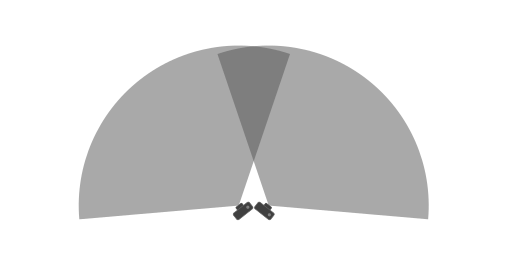
Most action cameras have a horizontal Field of View (FOV) of about 120 degrees. Some claim 170 degrees, which actually means the diagonal FOV. To make the 180-degree view, you'll need to place two cameras at an angle of 80 to 90 degrees. This creates an overlapped area of roughly 30 degrees, which is sufficient for ActionStitch to find feature points visible to both cameras.
You should expand the coverage to slightly more than 180 degrees to give enough space for cropping, in case the cameras are not facing precisely the right direction.
3D Printed Mounts
The recommended approach is 3D printing. You can print one from the list below if you own or have access to a 3D printer, or use a printing service such as Craftcloud.
| Camera | Angle | 3D Model |
|---|---|---|
| Firefly 8SE | 90° | firefly_8se.stl |
| Firefly X | 100° | firefly_x.stl |
| Osmo Action | 80° | osmo_action.stl |
| GoPro Hero 10 Black | 90° | gopro_10.stl |
| GAMSOD | 100° | gamsod.stl |
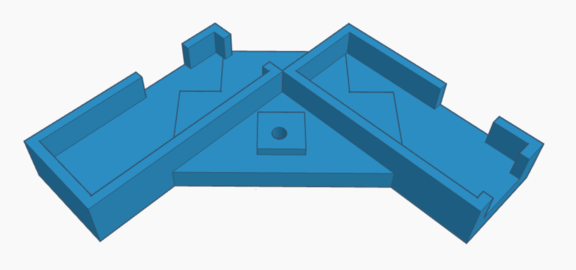
Camera not on the list? Send us your camera dimensions and we'll create the 3D model for you.
It is also possible to make your own mount with an aluminum bar, or modify an off-the-shelf dual camera mount. However, a 3D printed mount is much easier to set up.
Tripods
It is highly recommended that cameras be placed on a tall tripod, at least 12 feet, to make the video look much better. There are many 12–13 foot tall tripods sold as light stands on Amazon that work perfectly, as action cameras are lightweight.
For outdoor big fields you may need one as tall as 20 feet. Tripods in this range can be expensive. The cheapest one that works well is the Glide Gear TST 20, priced at $299.
Important: When setting up a tall tripod outdoors on a windy day, hold the tripod at all times or place weight bags on the legs to stabilize it.